Summary – Most AI tools today can generate clean and readable content. However, only a small number of tools are capable of producing content that is properly structured, semantically complete, and optimized to rank in search engines and appear in AI-generated answers.
After testing multiple tools for best tools for llm seo, one clear pattern emerged: content performance is not driven by writing quality alone. It depends on how well the content aligns with real ranking factors such as structure, topical depth, and keyword relevance.
Key Takeaways
- Writing quality alone is no longer enough to rank in search engines
- Most AI tools fail to meet basic on-page SEO requirements
- Even “SEO-optimized” prompts produce inconsistent results
- Structured, data-backed content performs significantly better
- Tools designed specifically for SEO consistently outperform general AI models
If you ask any AI tool to “write SEO-friendly content,” it will generate something that looks complete and polished.
I have tested this across multiple tools and workflows.
At first glance, the output looks impressive. The sentences are clear. The grammar is correct. The structure appears logical.
But once that content is published, the results often tell a different story.
In many cases:
- The page does not rank
- Traffic does not come
- Sometimes the page is not even indexed
This is a common issue many content creators are now facing.
The core problem is simple:
Good writing and ranking content are not the same thing anymore.
To understand this better, I ran a structured comparison of different tools to see which ones actually produce content that performs.
Table of Contents
The Common Assumption About AI and SEO
A widely held belief in content marketing is:
“If the content is well written, search engines will understand and rank it.”
This idea worked to some extent in the past.
For example, between 2015 and 2019, many low-competition keywords could rank with basic blog posts that simply explained a topic clearly.
However, search algorithms have evolved significantly.
Recent studies suggest that:
- Over 90 percent of web pages receive no organic traffic
- The top 10 results capture more than 70 percent of clicks
- Content that ranks consistently tends to follow very similar structural patterns
In 2026, ranking content typically shares these characteristics:
- Clear heading hierarchy
- Comprehensive topic coverage
- Inclusion of semantically related terms
- Balanced readability and depth
This means writing quality alone is no longer enough.
What Was Tested For Best Tools For LLM SEO
To identify the best tools for LLM SEO, I didn’t just look at how well these tools write—I focused on how well their output performs from a ranking perspective.
Because in real-world scenarios, content is not judged by how “good” it sounds. It is judged by:
- Whether it gets indexed
- Whether it ranks
- Whether it brings traffic
From my own testing across multiple websites, I have repeatedly noticed that two articles can have similar writing quality, but only one ranks. The difference almost always comes down to structure, coverage, and optimization signals.
So instead of relying on assumptions, I created a controlled testing setup.
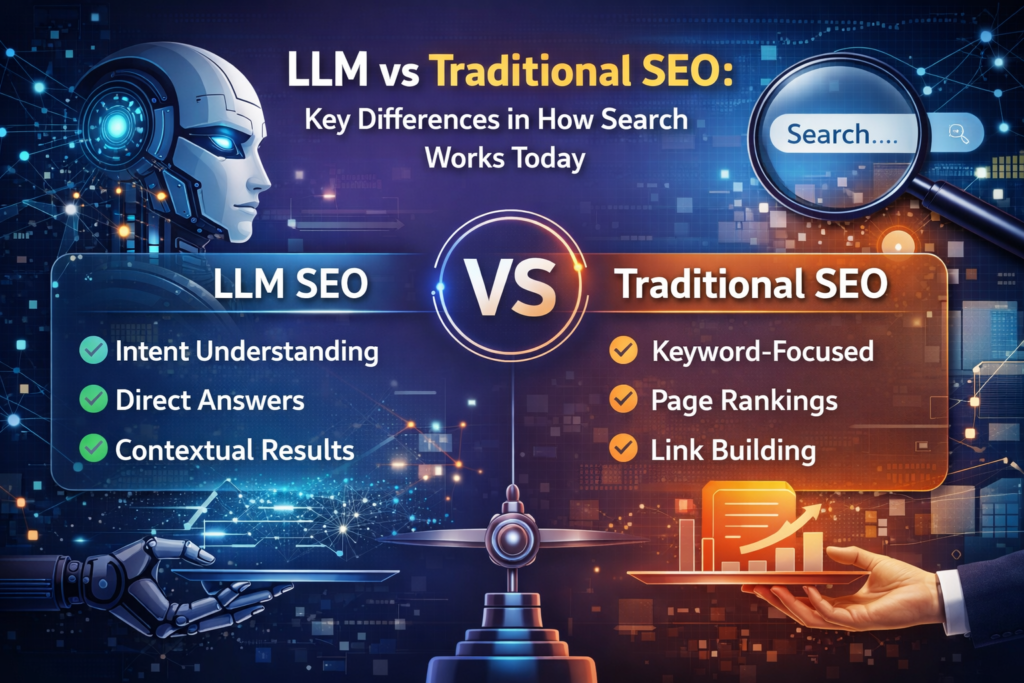
Also read – LLM vs traditional seo
Testing Approach
Each tool was tested under two specific conditions to simulate real usage patterns.
1. Basic Prompt (Unoptimized Input)
“Write an article about [topic]”
This reflects how most users actually interact with AI tools, especially beginners.
In this scenario:
- No keyword guidance is provided
- No SEO instructions are given
- The model relies entirely on its internal training
From experience, this type of prompt usually produces:
- Clean and readable content
- Generic structure
- Surface-level coverage
However, it often misses:
- Important subtopics
- Proper heading hierarchy
- Search intent alignment
This test helps answer an important question:
How good is the tool without any SEO guidance?
2. SEO Prompt (Optimized Instruction)
“Write an SEO-optimized article about [topic]”
This reflects a more advanced user approach.
Here, the expectation is that the tool will:
- Apply SEO best practices
- Improve structure
- Include relevant keywords
- Expand topic coverage
In theory, this should produce significantly better results.
However, in practice, I have noticed that different tools interpret “SEO” very differently.
- Some tools: Add more headings, but keep content shallow
- Others: Increase keyword usage but lose readability
- A few: Make minimal changes at all
This test helps evaluate:
Whether the tool actually understands SEO, or just reacts to the keyword “SEO.”
Evaluation Criteria for Best Tools for LLM SEO
Instead of judging content based on writing style or grammar, I evaluated outputs using practical, ranking-focused SEO indicators.
These are the same types of signals I have seen repeatedly in pages that rank on the first page.
1. Presence of a Title Tag
This is one of the most basic yet often missed elements.
A proper title tag:
- Defines the page topic clearly
- Helps search engines categorize the content
- Impacts click-through rates
In testing, I noticed that:
- Several tools skipped this entirely
- Others included a title but did not optimize it
This small detail alone can affect whether a page gets properly indexed.
2. Use of a Clear H1 Heading
The H1 acts as the main topic indicator for the page.
A strong H1:
- Matches search intent
- Includes the primary keyword naturally
- Sets the direction for the entire article
From experience, weak or missing H1s often lead to:
- Confused topic signals
- Lower ranking potential
Surprisingly, some tools either:
- Duplicate the title incorrectly
- Or fail to structure it properly
3. Number of Subheadings
Subheadings (H2, H3) are critical for both users and search engines.
They:
- Improve readability
- Break down complex topics
- Help search engines understand content structure
From analyzing ranking pages, I have consistently seen that:
- Most well-performing articles include 5 to 9 structured subheadings
In testing, many AI tools:
- Used only 3–4 headings
- Or created headings without depth
This results in content that feels incomplete.
4. Depth of Content Coverage
This is one of the biggest ranking factors.
Content depth is not just about word count. It is about:
- Covering all important angles of a topic
- Answering related questions
- Providing useful detail
For example, a strong article on “LLM SEO tools” should include:
- What LLM SEO is
- Tool comparisons
- Use cases
- Limitations
- Practical recommendations
In testing, I observed that:
- Many tools stopped at basic explanations
- Very few expanded into deeper insights
This leads to content that cannot compete with top-ranking pages.
5. Inclusion of Related (NLP) Terms
Search engines no longer rely on exact keywords alone.
They look for:
- Contextual relevance
- Related phrases
- Semantic connections
For example, an article about LLM SEO should naturally include terms like:
- AI content optimization
- semantic relevance
- search intent
- ranking signals
From testing:
- Most tools included some related terms
- But very few reached strong semantic coverage
This limits how well the content is understood by search engines.
6. Overall Structure and Completeness
This is where everything comes together.
A well-optimized page should feel:
- Complete
- Balanced
- Easy to navigate
From experience, content that performs well usually:
- Follows a logical flow
- Covers the topic fully
- Avoids gaps
In contrast, weaker outputs often:
- Jump between ideas
- Miss important sections
- End abruptly without fully addressing the topic
Practical Insight From Testing
After reviewing multiple outputs across different tools, one pattern became very clear:
Content begins to perform only when it meets a minimum threshold across all these factors—not just one or two.
For example:
- A well-written article with poor structure does not rank
- A structured article with low depth also struggles
- A detailed article without semantic relevance gets ignored
But when all elements are aligned:
- Indexing improves
- Rankings become more stable
- Traffic potential increases
This is the key difference between:
- Content that looks good
- And content that actually performs
Tools Included in the Comparison of Best Tools for LLM SEO
The test included a mix of widely used AI models and specialized tools:
| Tool | Description |
|---|---|
| Claude Sonnet 4.6 | A balanced model built for structured writing and clarity. It performs well for long-form content, but from my testing, it still needs additional SEO optimization to rank effectively. |
| Claude Opus 4.6 | A high-performance model designed for deep reasoning and complex content. While strong in detail, it does not consistently produce fully optimized SEO content without guidance. |
| Gemini 3 Pro | Google’s advanced AI model with strong contextual understanding. It improves with SEO prompts, but often lacks consistency in structure and full topic coverage. |
| GPT-5.2 | A next-generation model focused on long-context and structured outputs. It generates high-quality content but behaves more like a writing tool than an SEO optimizer. |
| GPT-4.1 | A widely used and reliable model for structured writing and automation. It performs well overall but still misses deeper SEO signals needed for competitive rankings. |
| Llama 4 Maverick Instruct | An open-weight model designed for flexibility and customization. Its SEO performance depends heavily on configuration, with default outputs lacking optimization. |
| Perplexity Pro | A research-focused AI tool with real-time data and citations. Strong for information gathering, but not built for fully optimized long-form SEO content. |
| Grok 4 | A fast, trend-aware AI model designed for real-time content. It prioritizes speed and tone, but often lacks structured SEO optimization. |
| Mistral Large 3 | A performance-focused model with strong multilingual capabilities. It produces readable content, but often lacks depth and SEO structure. |
| DeepSeek V3.x | A cost-efficient model with strong reasoning capabilities. It improves with SEO prompts, but still falls short in consistent optimization. |
| Qwen 3.5 | A multilingual AI model designed for global content generation. Its SEO outputs are inconsistent and often miss key structural elements. |
| Doubao 2.0 | A large-scale conversational model built for content ecosystems. It provides moderate structure but lacks the depth needed for ranking. |
| POP AI Writer | A tool specifically built for SEO content creation using structured frameworks. From testing, it consistently produces content aligned with ranking signals and optimization requirements. |
What We Measured and Why It Matters
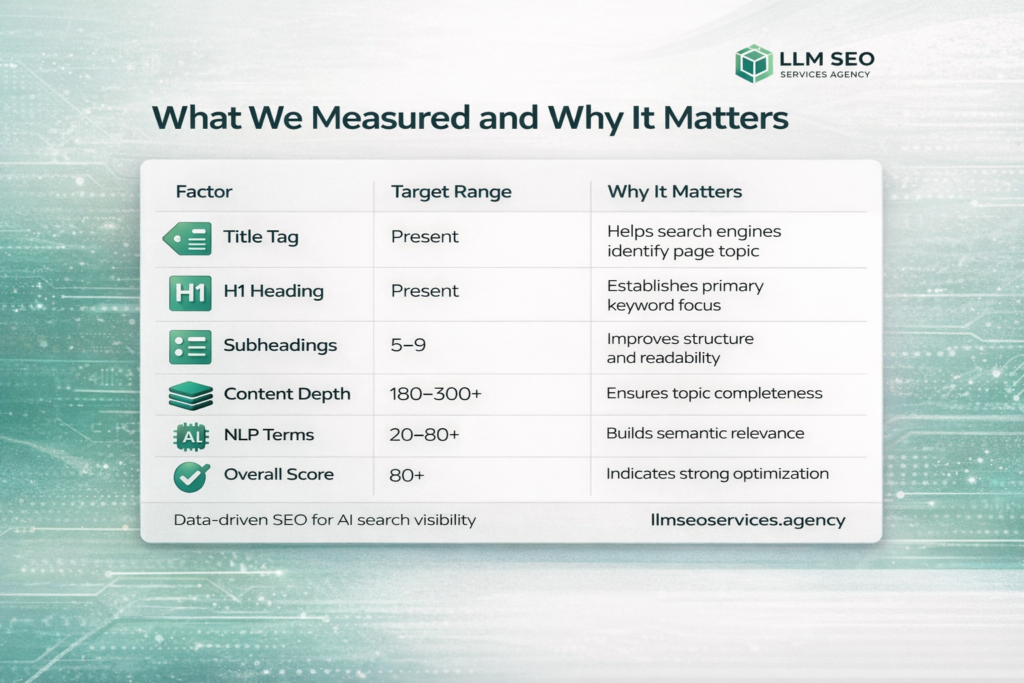
In practical terms, I have observed that content below this threshold tends to struggle, while content above it begins to gain traction more consistently.
Results Overview
After running the tests for best tools for llm seo, the results were quite revealing.
- Most tools improved slightly when given an SEO prompt
- However, the majority still failed to meet key structural benchmarks
- Only one tool consistently met all criteria
Performance Summary
| Tool | SEO Score | Subheadings | Content Depth | NLP Terms |
| POP AI | 100 | 8 | 206 | 85 |
| GPT-4.1 | 72.8 | 4 | 81 | 12 |
| Claude Opus | 71.5 | 4 | 78 | 24 |
| Gemini | 70.9 | 4 | 103 | 28 |
| DeepSeek | 71.4 | 4 | 94 | 18 |
| Others | Below 70 | 3–5 | Inconsistent | Low |
What These Results Show
1. Structure Is the Biggest Gap
Most tools:
- Used fewer headings than required
- Did not fully expand on the topic
- Missed important subtopics
For example, when writing about “LLM SEO tools,” many outputs:
- Focused only on tool lists
- Ignored how those tools impact rankings
- Did not explain optimization principles
This leads to incomplete content.
2. Content Depth Is Often Insufficient
Many AI-generated articles stay within 800–1200 words and avoid detailed explanations.
However, high-ranking pages typically:
- Cover multiple angles of a topic
- Include comparisons, examples, and data
- Address related questions
Without this depth, content struggles to compete.
3. SEO Prompts Have Limited Impact
Adding “SEO-optimized” to a prompt does improve output slightly.
For example:
- Some tools increased heading usage
- Others included more keywords
But the improvements were inconsistent.
In some cases, the output even became less structured.
This shows that:
The term “SEO” is interpreted differently by each model and is not a reliable instruction.
Why General AI Tools Struggle with SEO
From testing and observation, the reason is clear.
General AI tools are designed to:
- Generate human-like text
- Follow instructions broadly
- Maintain readability
They are not designed to:
- Analyze ranking pages
- Identify missing SEO elements
- Ensure complete optimization
This leads to content that looks good but lacks performance signals.
Why LLM SEO Optimization Tools Perform Better
Tools built specifically for SEO take a different approach.
They:
- Follow predefined optimization frameworks
- Ensure coverage of important terms
- Maintain required structure
- Align with patterns seen in ranking pages
For example, instead of guessing how many headings to include, these tools:
- Set a target range
- Ensure the output meets that range
From my own testing, this consistency is what makes the biggest difference.
Practical Use Cases
When to Use General AI Tools
- Brainstorming topics
- Creating outlines
- Rewriting content
- Testing different tones
When to Use SEO-Focused Tools
- Writing final blog posts
- Optimizing existing pages
- Targeting competitive keywords
- Creating content for long-term ranking
Conclusion
The testing clearly shows that the gap between “AI-generated content” and “ranking content” still exists.
Most tools are good at writing.
Very few are good at optimizing.
If your goal is simply to produce content, general AI tools are enough.
But if your goal is to rank, generate traffic, and appear in AI-driven search results, then you need tools that go beyond writing and focus on optimization.
Frequently Asked Questions
What are the best tools for LLM SEO?
The best tools are those that combine AI writing with structured SEO optimization. General AI tools are useful, but they need additional optimization to perform well.
Why does AI content fail to rank?
Most AI content fails because it lacks:
Proper structure
Sufficient depth
Semantic keyword coverage
Can AI tools replace SEO tools?
No. AI tools assist with content creation, but SEO tools are needed to ensure the content meets ranking requirements.
What is the difference between AI writing and LLM SEO?
AI writing focuses on generating text. LLM SEO focuses on creating content that aligns with search engine and AI answer systems.
How do I improve AI-generated content?
You can improve it by:
Adding structured headings
Expanding topic coverage
Including related keywords
Reviewing competitor pages