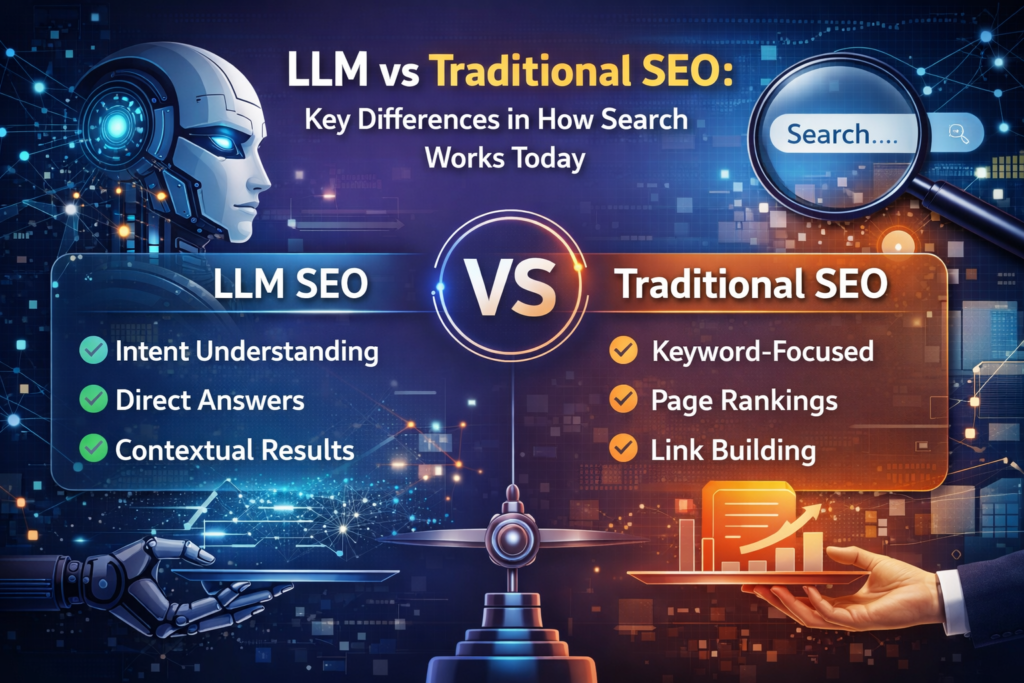
LLM vs traditional SEO comes down to one core difference: traditional SEO helps your content rank in search engines, while LLM SEO ensures your brand and content are included in AI-generated answers. In the debate of llm seo vs traditional seo, SEO focuses on visibility through rankings and clicks, whereas LLM optimization focuses on influence through mentions, explanations, and recommendations. As AI-powered search grows, understanding how these two approaches differ is essential for maintaining both discoverability and decision-making impact in modern search environments.
TL;DR
- Traditional SEO = Helps you rank and get clicks
- LLM SEO = Helps you get mentioned in AI-generated answers
- SEO focuses on pages, keywords, and backlinks
- LLM optimization focuses on entities, clarity, and consistency
- You can rank well and still be invisible in AI answers
- You need both SEO and LLM optimization for complete search visibility
Key Takeaways
- LLM vs traditional SEO is about influence vs visibility
- SEO helps users find you; LLM SEO helps AI recommend you
- Ranking does not guarantee AI inclusion
- Clarity and consistency matter more than keyword density
- AI systems prefer explainable, structured content
- Brands that optimize for both gain a competitive advantage
Table of Contents
The Shift: Search Is No Longer Just About Rankings
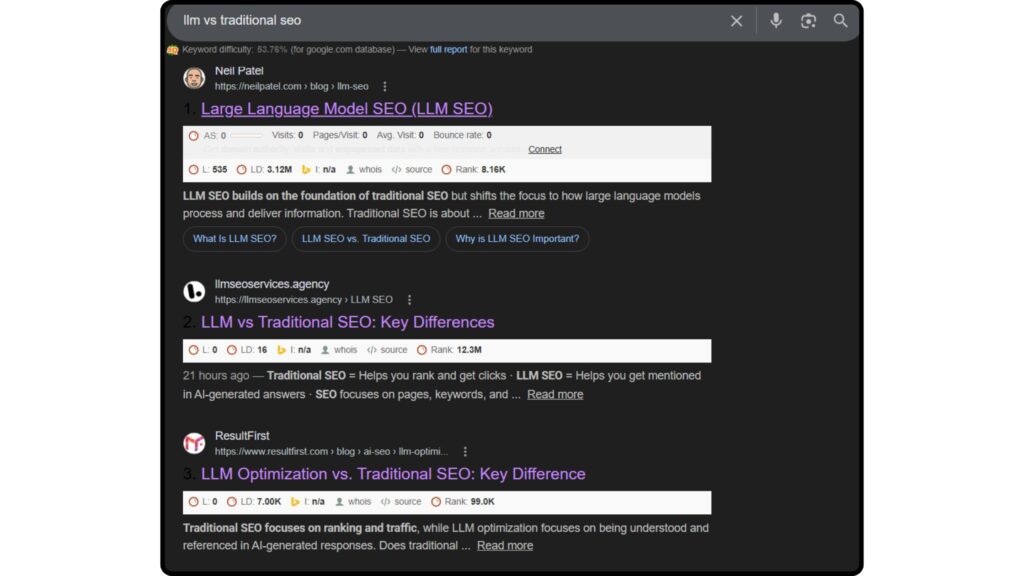
Search optimization is no longer governed by a single system. Traditional SEO still shapes how websites are indexed and ranked, but a new layer of discovery has emerged.
Large language models now influence how users receive answers, recommendations, and explanations across search engines, AI assistants, and generative interfaces.
This has introduced a growing disconnect. Many organizations see stable rankings and healthy crawl metrics, yet notice their brand, products, or content are absent from AI-generated responses.
Visibility exists, but influence does not.
This gap is where the difference between LLM vs traditional seo becomes clear. While both aim to improve discoverability, they operate on fundamentally different principles.
Traditional SEO Was Built for Retrieval, Not Reasoning
Traditional SEO is designed around retrieval systems.
Search engines crawl pages, index content, evaluate relevance signals, and rank results based on a combination of authority, relevance, and technical quality.
Success is measured by:
- Rankings
- Traffic
- Click-through rates
- Conversions
This model assumes that users will choose from a list of results and explore websites to find answers.
Traditional SEO still matters because:
- It controls indexation and crawl access
- It establishes baseline visibility
- It supports transactional and navigational queries
- It drives measurable traffic and revenue
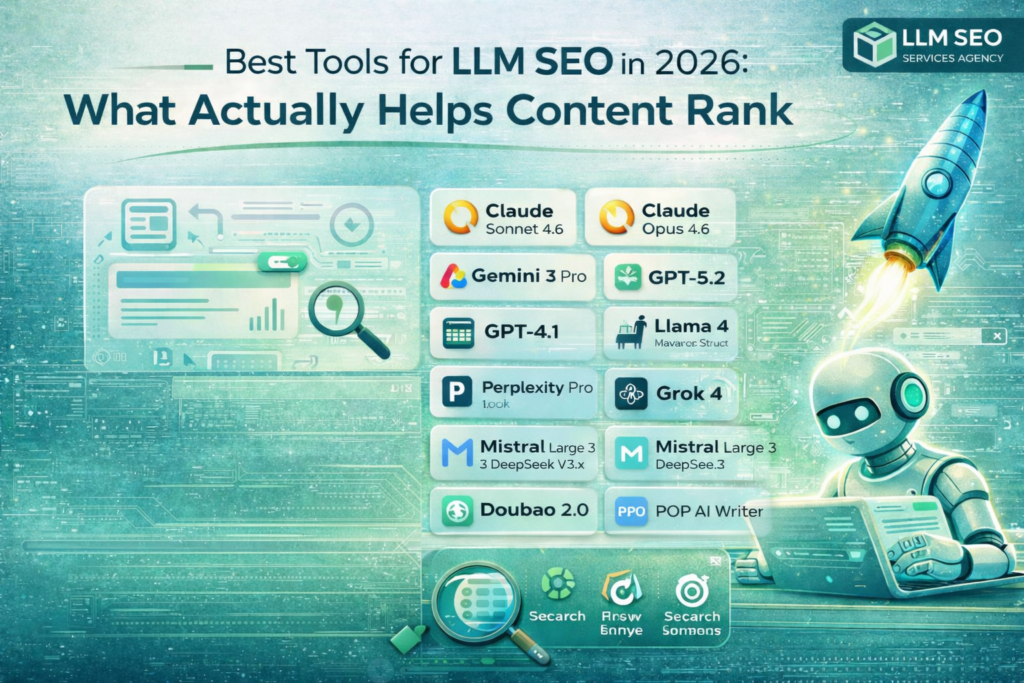
However, it was never designed to influence how answers are constructed. It optimizes for being found, not for being referenced. You can check the best LLM SEO tools in 2026 if you are writing any content, or you can also learn more about LLM vs Traditional SEO.
LLM SEO Operates on Understanding, Not Indexing
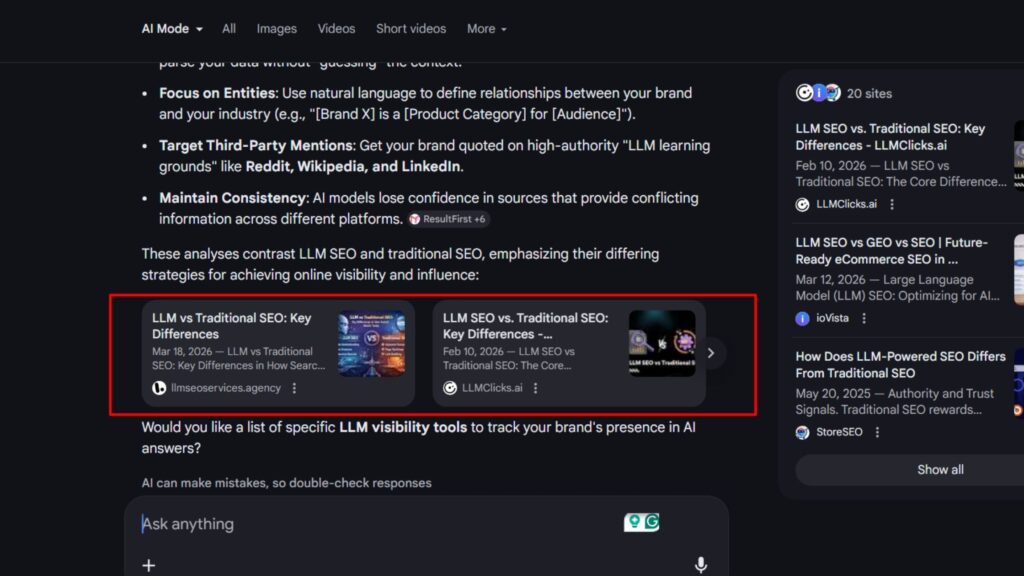
LLM SEO works in a fundamentally different environment.
Large language models do not retrieve pages to display them. They synthesize information to generate responses. Their goal is not to rank content, but to reduce uncertainty by providing clear, confident answers.
This changes the optimization target.
LLM optimization focuses on:
- Whether a brand or concept is understood as an entity
- How consistently does information appear across sources
- Whether explanations are clear enough to reuse
- How confidently a model can reference a source or brand
In LLM-driven experiences, content does not “rank.” It is either incorporated into answers or ignored.
Visibility vs Influence: The Core Difference That Matters
The most important distinction in llm seo vs traditional seo is the difference between visibility and influence.
Traditional SEO visibility means:
- A page appears in search results
- A user can click through to learn more
LLM influence means:
- A brand is mentioned in the generated answers
- A product is referenced in recommendations
- A concept is explained using your content as context
You can have strong traditional visibility and still lack LLM influence. This is why some well-ranking sites are absent from AI summaries, while others with lower traffic appear consistently.
LLM vs Traditional SEO: Key Differences in Practice
| Aspect | Traditional SEO | LLM SEO |
| Primary Purpose | Rank pages and earn clicks | Be referenced in AI-generated answers |
| Visibility | Search result rankings | Inclusion in AI responses |
| Evaluation | Pages, keywords, backlinks | Entities, concepts, explanations |
| Success Signal | Traffic, CTR, conversions | Mentions, citations, contextual use |
| Content Focus | Keyword optimization | Clarity and consistency |
| Structure | Supports crawling | Enables reuse and synthesis |
| Consistency | Flexible | Critical for AI confidence |
| Influence Stage | After click | Before click |
| Measurement | Rankings and sessions | Influence and recall |
| Failure Pattern | Low rankings | Invisible in AI answers |
How Each System Evaluates Content Differently
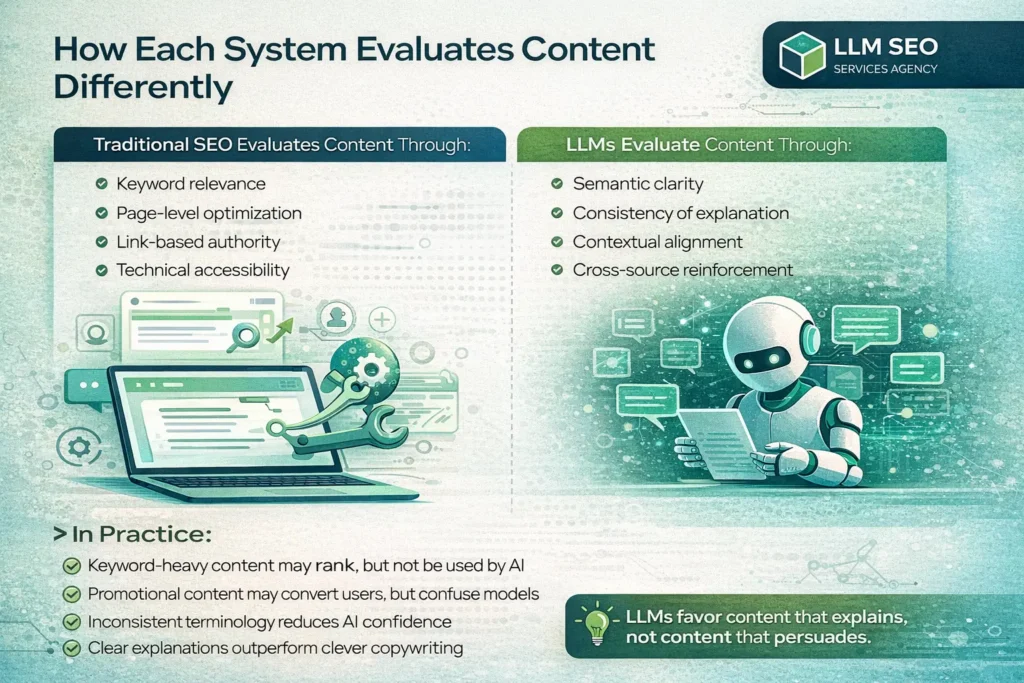
Traditional SEO evaluates content through:
- Keyword relevance
- Page-level optimization
- Link-based authority
- Technical accessibility
LLMs evaluate content through:
- Semantic clarity
- Consistency of explanation
- Contextual alignment
- Cross-source reinforcement
In practice:
- Keyword-heavy content may rank, but not be used by AI
- Promotional content may convert users, but confuse models
- Inconsistent terminology reduces AI confidence
- Clear explanations outperform clever copywriting
LLMs favor content that explains, not content that persuades.
Why SEO-Optimized Content Can Fail in LLMs
You will get to know, while reading about LLM vs Traditional SEO, why content fails. Many assume that strong SEO automatically leads to strong AI visibility. This is often not true.
Common issues include:
- Content optimized for search engines, not understanding
- Pages designed for conversion instead of explanation
- Fragmented product or topic definitions
- Inconsistent language across platforms
Traditional SEO tolerates inconsistency if authority is strong. LLMs do not. Uncertainty leads to exclusion.
How do Content Structure Changes in LLM SEO?
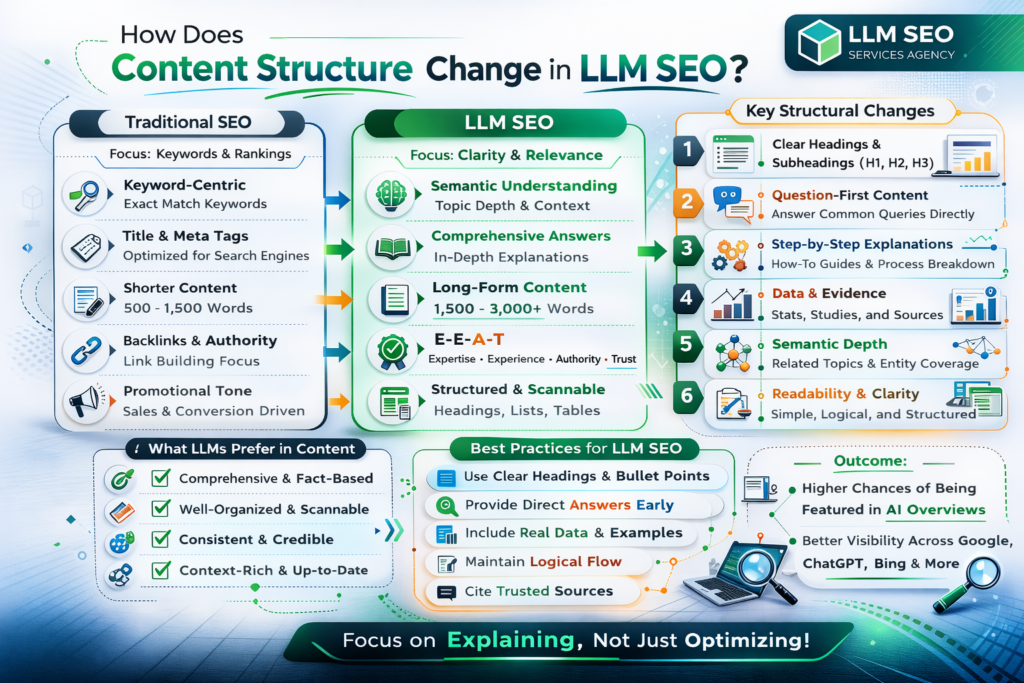
In traditional SEO, structure supports ranking and scanning.
In LLM SEO, structure supports reuse.
Content that performs well in LLM systems:
- Defines concepts clearly
- Separates ideas cleanly
- Avoids vague language
- Maintains consistency across pages
- Builds understanding step-by-step
This ensures content can be extracted, summarized, and recombined without losing meaning.
Measurement Looks Different in LLM SEO
Traditional SEO success is visible in analytics dashboards.
LLM SEO success is indirect but measurable through patterns.
Key signals include:
- Appearance in AI-generated answers
- Increased branded search queries
- Higher conversion efficiency
- Stronger presence in comparison queries
- Improved recall during decision-making
LLM optimization influences decisions earlier, even before users visit your site.
Why You Need Both: LLM SEO vs Traditional SEO Is Not a Choice
The discussion of LLM vs. traditional seo is not about replacement. It is about alignment.
Traditional SEO ensures:
- Your site can be found
- Your pages can rank
- Demand can reach you
LLM SEO ensures:
- Your brand is understood
- Your content is trusted
- Your information is reused in AI answers
One without the other creates an imbalance.
Strategic Takeaway: SEO Gets You Seen, LLM SEO Gets You Chosen
Traditional SEO and LLM SEO serve different roles in the same ecosystem.
SEO ensures presence.
LLM SEO shapes perception.
As search evolves toward AI-driven experiences, success depends on aligning both strategies. Organizations that treat them as interchangeable risk losing influence at the most critical stage — decision-making.
Conclusion
The difference between llm seo vs traditional seo is no longer theoretical. It is visible in how search works today.
Ranking alone is no longer enough. Being included in AI-generated answers is becoming equally important.
Adapting to this shift requires expanding beyond traditional SEO into LLM optimization. By focusing on clarity, consistency, and entity understanding, businesses can bridge the gap between being visible and being influential.
Modern search success depends on both being found and being chosen.
FAQs
Is Traditional SEO still relevant in 2026?
Yes, Traditional SEO is still relevant. However, it is evolving. While rankings and organic traffic remain important, visibility in AI-generated answers is becoming equally critical.
How do AI search engines differ from traditional search engines?
Traditional search engines show a list of links based on ranking signals.
AI search engines provide direct answers, summaries, and recommendations by analysing multiple sources instead of just ranking pages.
What are the key ranking factors in Traditional SEO?
Keywords
Backlinks
Technical SEO (site speed, mobile-friendliness)
On-page optimisation
User experience
What are the key factors in LLM SEO?
Content clarity and context
Semantic relevance
Authority and trust (E-E-A-T)
Structured data and formatting
Answer-focused content
Can LLM SEO replace Traditional SEO?
No, LLM SEO will not replace Traditional SEO. Instead, both will work together. Traditional SEO drives discoverability, while LLM SEO enhances visibility in AI-generated responses.